These two terms get thrown around like they’re the same thing, and honestly, most people just nod along without really knowing the difference. Someone says “funnel,” someone else says “pipeline,” and the room just agrees. But once the sales funnel is separated properly from the pipeline, things actually start making a lot more sense — and decisions get made with far less confusion. Nod if you are guilty of using these two words interchangeably but with harmless intentions. And shed that guilt as you no longer have to stay confused.
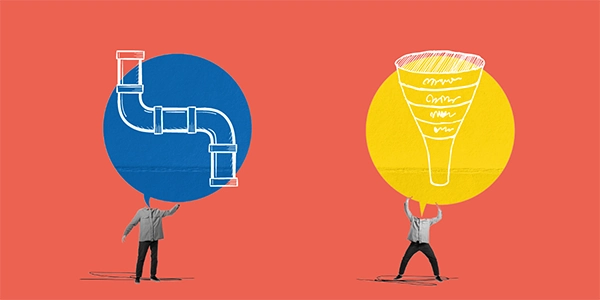
Think of the funnel as the customer’s journey. It’s wide at the top, where a bunch of people are just becoming aware a product exists; there are those who are actively seeking a solution provided by your product and then there are those whose interest is piqued through active and passive advertising. And it narrows down as fewer and fewer of them actually move toward buying. Awareness, interest, consideration, decision — that’s the flow. It’s told from the buyer’s side of the story, not the seller’s.
The pipeline, on the other hand, is the sales team’s view of the same journey. It’s a map of stages a deal goes through — prospecting, qualifying, proposal, negotiation, closing. Instead of tracking how the customer feels, it tracks what the sales rep is actually doing at each point. It’s less about emotion, more about action.
Both deal with movement from a stranger to a paying customer, so it’s easy to see why they get mixed up. But one is passive and observational, while the other is active and operational. The funnel is watched, the pipeline is worked. That difference alone changes how each should be measured.
If a question is being asked like “how many people know about us,” that’s funnel talk. If the question sounds more like “how many deals are sitting in negotiation right now,” that’s pipeline talk. One is marketing’s territory mostly, the other belongs to sales.
When these two get treated as the same, wrong conclusions get drawn. A shrinking funnel might mean marketing needs fixing, while a stuck pipeline usually points to a sales process problem. Mixing them up leads to the wrong department getting blamed, and that wastes time nobody has spare.
Even though they’re different, they’re not enemies — they’re teammates. Leads exit the funnel and enter the pipeline. A weak funnel starves the pipeline of leads, and a broken pipeline wastes whatever the funnel manages to bring in. Fix one without the other, and growth still stalls.
So next time someone says funnel when they mean pipeline, it’s fine to let it slide in casual talk — but internally, the difference should be kept clear. Marketing owns the funnel, sales owns the pipeline, and revenue is only unlocked when both are working in sync, not competing for credit.